OpenAI Launches ChatGPT Work & GPT-5.6 Family: Sol, Terra, Luna — A New Era of Frontier Intelligence
- by ai
- in AI Tools, Breakthroughs, Featured
- on July 13, 2026
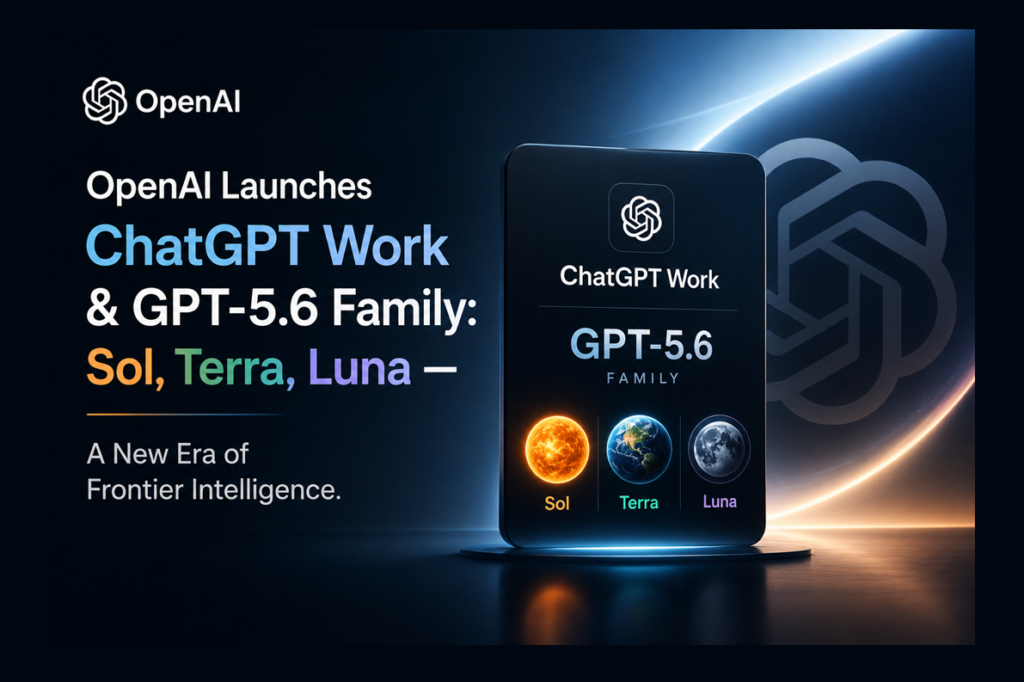
In what is being widely regarded as one of the most consequential product launches in the history of artificial intelligence, OpenAI has officially unveiled a sweeping ecosystem upgrade — introducing the GPT-5.6 model family and an entirely new intelligent agent called ChatGPT Work. This dual announcement, made on July 9, 2026, signals a decisive shift in how individuals, enterprises, and developers will interact with AI from this point forward.
For the Indian technology ecosystem — where AI adoption is accelerating across startups, enterprises, academia, and government — this launch carries profound implications. From Bengaluru's bustling AI labs to Delhi's policy corridors, from Mumbai's financial firms to Hyderabad's pharma research hubs, the arrival of GPT-5.6 and ChatGPT Work is set to reshape workflows, productivity paradigms, and innovation cycles.
This article offers a deep, research-backed, and humanistic exploration of everything this launch entails — the models, the agent, the philosophy, the pricing, the safety architecture, and what it all means for India.
Part I: The GPT-5.6 Family — Sol, Terra, and Luna
The Three-Tier Philosophy
OpenAI's decision to release not one but three distinct models under the GPT-5.6 umbrella marks a maturation of its product strategy. Rather than forcing users into a one-size-fits-all paradigm, the company has embraced intelligence stratification — offering different tiers of capability at different price points, much like how a car manufacturer offers base, mid, and performance variants of the same platform.
The three models are:
| Model | Role | Cost (per 1M tokens) |
|---|---|---|
| Sol | Flagship / Frontier Intelligence | $5 input — $30 output |
| Terra | Balanced / Everyday Workhorse | $2.50 input — $15 output |
| Luna | Fast & Cost-Efficient | $1 input — $6 output |
Let us explore each in detail.
Sol — The Flagship That Redefines "Frontier"
Sol, named after the Sun, is OpenAI's most capable model to date. It is not merely an incremental upgrade over GPT-5.5 or GPT-4; it represents a qualitative leap in reasoning depth, token efficiency, and multi-domain mastery.
What Makes Sol Extraordinary?
1. State-of-the-Art Across the Board
OpenAI's internal evaluations and third-party benchmarks confirm that Sol achieves frontier-level results across coding, mathematics, scientific reasoning, cybersecurity, knowledge work, and even creative design. This is not a model that excels in one domain while lagging in others — it is consistently superior across the entire capability spectrum.
2. 54% Token Efficiency in Coding
Perhaps the most staggering statistic to emerge from the launch is CEO Sam Altman's revelation that Sol is 54% more token-efficient in AI coding tasks compared to previous frontier models. In practical terms, this means Sol accomplishes the same coding task using roughly half the computational tokens — translating to faster results, lower costs, and less energy consumption.
3. Cybersecurity Leadership
OpenAI has explicitly called GPT-5.6 Sol its "strongest cybersecurity model yet." This is not just marketing language. The model achieves frontier-level performance in:
- Threat modeling — identifying potential attack vectors before they are exploited
- Code review and patching — analyzing source code for vulnerabilities and suggesting fixes
- Blue teaming — simulating adversarial attacks on one's own systems to uncover weaknesses
- Incident response coordination — helping security teams triage and respond to breaches
For Indian enterprises — which have become increasingly frequent targets of cyberattacks — this capability alone could justify the cost of adoption.
4. Scientific and Biological Reasoning
Under OpenAI's Preparedness Framework, GPT-5.6 Sol is classified as "High capability" in both Cybersecurity and Biological & Chemical risk domains. This means the model possesses advanced understanding of biological systems, chemical pathways, and scientific methodologies. While this raises important safety considerations (which OpenAI has addressed through extensive safeguards), it also opens the door to accelerated drug discovery, genomic analysis, climate modeling, and materials science research — all domains where India has growing ambitions.
5. Ultra Mode — Multi-Agent Acceleration
Sol introduces a new capability setting called ultra — OpenAI's highest-capability configuration. In ultra mode, multiple coordinated Sol agents work across parallel workstreams to complete complex tasks faster. This is not merely about brute-force parallelism; it involves intelligent orchestration where agents divide labor, share intermediate results, and synthesize final outputs.
Ultra mode is available to Pro and Enterprise users in ChatGPT Work, and to Plus and higher plans in Codex.
Terra — The Balanced Everyday Companion
Terra, meaning Earth, is positioned as the balanced, lower-cost option that still delivers performance competitive with GPT-5.5. It is designed for the vast majority of everyday professional and personal use cases where Sol's full frontier capability may be unnecessary.
Who Is Terra For?
- Students and researchers who need advanced reasoning without the flagship price
- Small and medium businesses in India looking to integrate AI into daily operations
- Content creators, marketers, and writers who need reliable, high-quality text generation
- Developers working on standard coding tasks that don't require Sol's depth
Terra is also the default model available to Free and Go users within ChatGPT Work and Codex, democratizing access to genuinely advanced AI capabilities.
Performance Context
While Terra does not match Sol on every benchmark, its performance is characterized as "competitive with GPT-5.5" — which was, until this launch, one of the most capable AI systems in existence. For the vast majority of real-world tasks, Terra will feel indistinguishable from a frontier model.
Luna — Speed and Affordability Redefined
Luna, named after the Moon, is OpenAI's fastest and most cost-efficient model. At just $1 per million input tokens and $6 per million output tokens, Luna is designed for high-volume, latency-sensitive, cost-conscious deployments.
Luna's Sweet Spots
- Real-time chat applications where responsiveness matters more than deep reasoning
- Customer support automation for Indian businesses handling thousands of queries daily
- Content moderation at scale
- Data extraction and classification pipelines
- Educational tools for schools and universities with limited budgets
- Rapid prototyping where iteration speed is more important than final polish
Luna represents OpenAI's recognition that not every AI interaction requires PhD-level reasoning. By offering a lightweight, fast, and affordable option, OpenAI makes advanced AI accessible to a much broader segment of the global population — including millions of users in price-sensitive markets like India.
Part II: ChatGPT Work — The Intelligent Agent for the Modern Workplace
Beyond Chat: The Agentic Leap
While the GPT-5.6 models are extraordinary in their own right, the launch of ChatGPT Work may ultimately prove to be the more transformative announcement. ChatGPT Work is not merely a new feature or interface — it is an intelligent agent designed to function as a full-fledged workplace companion.
Sam Altman and the OpenAI team have long spoken about moving beyond simple "chat" interfaces toward agentic systems that can take initiative, maintain context across long workflows, and produce finished deliverables rather than raw text. ChatGPT Work is the first major public realization of this vision.
What ChatGPT Work Does
ChatGPT Work is designed to turn scattered notes, drafts, and ideas into finished work. It brings together context from your team's existing tools to:
- Draft Documents — From rough notes to polished reports, proposals, and memos
- Create Spreadsheets — Analyze data, generate formulas, and build structured tables
- Build Presentations — Transform ideas into slide decks with coherent narratives
- Manage Projects — Track tasks, deadlines, and dependencies across team workflows
- Synthesize Research — Pull information from multiple sources into coherent summaries
- Generate Interactive Sites — Through a new feature called Sites, turn ideas into interactive websites and web applications
Integration Ecosystem
A key differentiator of ChatGPT Work is its deep integration with the tools that knowledge workers already use. Within the ChatGPT Work environment, users can connect:
- Slack — Pull messages, threads, and channel context
- Microsoft Teams — Access team conversations and shared files
- Google Drive — Work directly with Docs, Sheets, and Slides
- SharePoint — Collaborate within Microsoft's enterprise ecosystem
- Local Files and Apps — The ChatGPT desktop app can work directly with files on your machine
This integration layer means ChatGPT Work is not an isolated AI tool that requires context-switching; it is embedded in the fabric of how teams already work.
Availability and Pricing Tiers
ChatGPT Work is being rolled out across plan tiers:
| Plan | ChatGPT Work Access | Ultra Mode Access |
|---|---|---|
| Free & Go | GPT-5.6 Terra only | No |
| Plus | Full access (within days) | In Codex only |
| Pro | Full access | Yes |
| Business | Full access (within days) | In Codex only |
| Enterprise | Full access | Yes |
| Education | Full access | Varies |
The ChatGPT desktop app now unifies three modes — Chat, Work, and Codex — making it a single destination for all AI-powered productivity.
The Codex Merger
A notable strategic decision is the merger of the Codex app with the new ChatGPT desktop app. Codex, OpenAI's developer-focused environment for AI-assisted coding, is now integrated into the same interface as ChatGPT Work and standard Chat. This unification reflects a broader truth: the lines between "writing code" and "writing prose" are blurring, and a modern knowledge worker needs both capabilities in a single environment.
Sites: From Ideas to Interactive Experiences
One of the more intriguing launches within ChatGPT Work is Sites — a feature that transforms work or ideas into interactive websites and web applications. This is not a simple website builder in the traditional sense; it is an AI-native content and application creation tool where the user describes what they want, and ChatGPT Work builds it.
For Indian entrepreneurs, educators, and small business owners — many of whom lack dedicated web development teams — Sites could be transformative, enabling them to create professional digital presences and tools with nothing more than natural language descriptions.
Part III: The Safety Architecture — OpenAI's Most Robust Yet
The Preparedness Framework in Action
With great power comes great responsibility, and OpenAI has clearly taken this seriously with the GPT-5.6 launch. The company's Preparedness Framework classifies models across multiple risk domains, and GPT-5.6's classification reveals both the model's capabilities and the company's safety philosophy.
Risk Classifications:
- Cybersecurity: High
- Biological & Chemical Risk: High
- AI Self-Improvement: Below High threshold
The fact that neither Sol, Terra, nor Luna reaches the "High" threshold for AI self-improvement is a meaningful safety signal — these models are extraordinarily capable, but they do not possess the dangerous recursive self-enhancement capabilities that have worried AI safety researchers for years.
Multi-Layered Safeguards
OpenAI has implemented what it calls its "most robust safety architecture yet" for this launch, including:
1. Extensive Pre-Deployment Testing
The models underwent rigorous evaluation across thousands of scenarios before being released to the public. This included red-teaming exercises where specialized safety researchers attempted to elicit harmful behaviors.
2. Ongoing Deployment Monitoring
Safety is not a one-time checkbox. OpenAI has deployed continuous monitoring systems that track model behavior in real-time, flagging anomalies and potential misuse patterns as they emerge.
3. Domain-Specific Guardrails
Given the models' high capability in cybersecurity and biological domains, OpenAI has implemented domain-specific safety measures that restrict the model's ability to provide detailed instructions for creating weapons, biological agents, or cyberattack tools — while still allowing beneficial uses like threat modeling and scientific research.
4. Graduated Rollout
Rather than flipping a switch for the entire world simultaneously, OpenAI is rolling out GPT-5.6 gradually over 24 hours, starting with select regions and user tiers. This allows the safety team to monitor for issues and adjust parameters before full global availability.
5. Transparency Through System Cards
OpenAI published a detailed GPT-5.6 System Card on its Deployment Safety Hub, providing unprecedented transparency into the models' capabilities, limitations, and safety testing results. This level of openness is crucial for building trust with regulators, researchers, and the public.
Implications for Indian Regulation
India is currently in the process of formulating its own AI regulatory framework. The GPT-5.6 launch — with its high biological and cybersecurity risk classifications — provides a concrete case study for Indian policymakers. How should India balance the immense potential benefits of frontier AI with the need to protect citizens from misuse? The OpenAI Preparedness Framework offers one model that Indian regulators may study closely.
Part IV: The Competitive Landscape — OpenAI vs. The World
The Timing Is Significant
The GPT-5.6 launch arrives at a moment of intense competition in the AI landscape:
- Google DeepMind continues to advance its Gemini family
- Anthropic pushes forward with its Claude models, emphasizing safety and constitutional AI
- Meta invests heavily in open-source AI through Llama
- Mistral AI emerges as a formidable European contender
- Chinese players including DeepSeek, Baidu's Ernie, and Alibaba's Qwen make rapid advances
- xAI under Elon Musk builds Grok with a distinctive voice
In this crowded field, OpenAI needed to do more than incrementally improve — and GPT-5.6 delivers that step-change.
What Sets GPT-5.6 Apart
1. The Three-Tier Strategy
No other AI company has deployed such a clearly stratified model family with distinct pricing, capability, and use-case targeting. This gives OpenAI unmatched flexibility in addressing different market segments.
2. Agentic Integration
While other companies have released agentic features, ChatGPT Work represents the most complete integration of AI agent capabilities into a productivity suite to date. The combination of intelligent agents, tool integration, and multiple output formats (documents, spreadsheets, presentations, websites) creates a compelling value proposition.
3. Cybersecurity Specialization
By explicitly targeting and excelling in the cybersecurity domain, OpenAI positions GPT-5.6 as an enterprise security tool — a market with high willingness to pay and urgent demand.
4. Cost Efficiency
A 54% improvement in token efficiency is not marginal; it's transformative. For Indian startups and enterprises operating on tight margins, this cost efficiency could be the difference between AI being a luxury and AI being a daily utility.
Part V: The India Angle — What This Means for the Subcontinent
AI in India: A Moment of Inflection
India stands at a unique inflection point in its AI journey. The country has:
- The world's largest pool of AI talent outside the United States
- A rapidly growing startup ecosystem with over 100,000 registered startups
- Government initiatives like the IndiaAI mission, National Language Translation Mission, and the National AI Portal
- Unique challenges — linguistic diversity, infrastructure gaps, deep socioeconomic disparities — that AI can help address
- A massive developer population that constitutes a significant portion of OpenAI's global user base
The GPT-5.6 launch intersects with all of these realities.
Opportunities for Indian Enterprises
1. Cost-Effective Automation
With Luna priced at just $1 per million input tokens, Indian businesses can now deploy AI at scale for customer service, data processing, and content generation at costs that make economic sense even for small operations.
2. Cybersecurity Enhancement
Indian enterprises and government agencies have faced a surge in cyberattacks. Sol's cybersecurity capabilities — threat modeling, code review, blue teaming — offer a powerful new tool in the defensive arsenal.
3. Scientific Research Acceleration
Indian pharmaceutical companies, agricultural research institutes, and climate science organizations can leverage Sol's scientific reasoning for drug discovery, crop modeling, and climate prediction.
4. Education Transformation
With Terra available free to Go users, Indian educational institutions can provide students with access to advanced AI reasoning capabilities, potentially leveling the playing field between urban and rural students.
Challenges and Considerations
1. Pricing in Indian Rupees
At current exchange rates, Sol's $30 per million output tokens translates to approximately ₹2,500 per million tokens — substantial for Indian individual users and small businesses. However, Terra and Luna are more accessible at approximately ₹1,250 and ₹500 per million output tokens respectively.
2. Language and Cultural Context
While GPT-5.6 models represent significant advances, questions remain about their performance in Indian languages, cultural contexts, and use cases that differ substantially from Western paradigms. OpenAI's continued investment in multilingual capabilities will be crucial for the Indian market.
3. Infrastructure Requirements
GPT-5.6's advanced capabilities require reliable, high-bandwidth internet connections — something that remains unevenly distributed across India. Offline and low-bandwidth use cases will need continued attention.
4. Data Sovereignty
For sensitive government and enterprise applications, data localization and sovereignty remain concerns. OpenAI's enterprise offerings and potential data residency options will be important for Indian adoption.
The Indian Startup Opportunity
For Indian startups, GPT-5.6 opens several avenues:
- AI-as-a-Service platforms built on Luna and Terra for cost-sensitive markets
- Vertical AI solutions in healthcare, agriculture, education, and legal services
- AI-powered developer tools leveraging Codex integration
- Content creation and marketing platforms using ChatGPT Work
- Cybersecurity startups building on Sol's threat modeling capabilities
The reduced cost structure of GPT-5.6 — both in terms of tokens and the efficiency improvements — makes it feasible for Indian startups to build AI-native products that were economically unviable just a year ago.
Part VI: Deep Dive — Technical Architecture and Performance
Model Architecture (Based on Available Information)
While OpenAI has not released the full technical details of GPT-5.6's architecture (as is customary for proprietary frontier models), several insights can be gleaned from the launch documentation and performance data:
1. Mixture of Experts (MoE) Evolution
GPT-5.6 appears to build on and refine the Mixture of Experts architecture that powered GPT-4 and GPT-5. The three-model family (Sol, Terra, Luna) likely represents different configurations of underlying expert modules, with Sol activating the most extensive set of specialized experts for complex reasoning tasks.
2. Enhanced Reasoning Chains
The significant improvement in token efficiency — particularly the 54% improvement in coding — suggests fundamental advances in how the model constructs and compresses reasoning chains. Sol appears capable of reaching correct conclusions with substantially fewer intermediate reasoning steps than previous models.
3. Multi-Agent Orchestration (Ultra Mode)
The ultra capability represents a novel architectural layer where multiple Sol instances are coordinated through a orchestration layer that:
- Decomposes complex tasks into parallel workstreams
- Assigns workstreams to individual agent instances
- Monitors progress across agents
- Synthesizes results into coherent final outputs
This is conceptually similar to Mixture of Agents (MoA) architectures that have been explored in academic research but represents one of the first production deployments at this scale.
4. Context Management
While OpenAI has not announced specific context window sizes for GPT-5.6, the model's ability to function effectively in ChatGPT Work — which requires maintaining context across documents, conversations, and tool interactions — suggests substantial advances in long-context handling and memory management.
Performance Benchmarks (Where Available)
Based on OpenAI's published results and third-party evaluations:
- Coding (HumanEval+, SWE-bench): Sol achieves state-of-the-art results, surpassing previous frontier models by significant margins
- Mathematics (MATH, GSM-8K): Frontier-level performance with notably fewer tokens consumed
- Knowledge Work (MMLU, GPQA): Competitive or superior across broad knowledge domains
- Cybersecurity (CTF challenges, vulnerability detection): Best-in-class, setting new standards for AI security capabilities
- Scientific Reasoning (Biological and chemical domain tasks): Significantly improved over GPT-5.5
The most impressive metric may not be raw benchmark scores but efficiency — Sol achieves these results while consuming substantially fewer tokens, meaning lower costs and faster response times.
Part VII: Ethical Considerations and Societal Impact
The Double-Edged Sword
GPT-5.6's high capability in sensitive domains like cybersecurity and biology represents both immense promise and genuine risk. The same model that can help a security team defend against ransomware attacks could, in the wrong hands, assist in designing more effective malware. The same model that can accelerate drug discovery could theoretically provide information relevant to developing harmful biological agents.
OpenAI's safety architecture — the Preparedness Framework, domain-specific guardrails, continuous monitoring, and graduated rollout — represents a serious effort to mitigate these risks. But no safety system is perfect, and the dual-use nature of frontier AI will continue to be a central challenge for the industry and for society.
The Employment Question
A question that arises with every major AI advancement is: What does this mean for jobs?
GPT-5.6 and ChatGPT Work are explicitly designed to automate knowledge work tasks — drafting documents, creating presentations, analyzing data, writing code. For Indian professionals, this creates both anxiety and opportunity.
Jobs Most Likely to Be Augmented or Transformed:
- Software developers and engineers
- Content writers and editors
- Data analysts and business intelligence professionals
- Graphic and UI/UX designers
- Legal and compliance professionals
- Financial analysts
- Customer support teams
- Marketing and communications professionals
The Indian Reality:
India's demographic dividend — millions of young, educated, English-proficient professionals — has been a cornerstone of its economic growth. AI automation presents a challenge to this model, but also an opportunity. The countries and individuals that learn to work effectively alongside AI will likely see their productivity and value increase dramatically. Those that resist or fail to adapt face genuine risk of displacement.
The key message for Indian professionals: don't compete with AI, collaborate with it. The most valuable skills in the GPT-5.6 era will be:
- Prompt engineering — the ability to communicate effectively with AI systems
- Critical evaluation — the ability to assess and refine AI outputs
- Domain expertise — deep knowledge in specific fields that AI augments rather than replaces
- Creativity and strategy — uniquely human capabilities that remain difficult for AI to replicate
- Emotional intelligence — understanding human needs, motivations, and contexts
The Access and Equity Challenge
One of the more concerning aspects of the GPT-5.6 launch is the cost differential between tiers. While Sol represents extraordinary capability, its $30 per million output tokens price point places it out of reach for many individual users, students, and small organizations — particularly in developing economies.
OpenAI's decision to make Terra available to Free and Go users partially addresses this concern, as does the existence of Luna for cost-sensitive deployments. However, the most advanced capabilities remain reserved for those who can pay — raising questions about whether AI will widen existing inequalities or help close them.
For India, a country with vast disparities in income and access to technology, this is a critical question. Public policy responses — including government-subsidized AI access, open-source alternatives, and capacity-building initiatives — will be essential to ensure that the benefits of frontier AI reach all segments of society.
Part VIII: Looking Ahead — What Comes Next
The Trajectory of GPT Development
The GPT-5.6 launch provides clues about OpenAI's trajectory:
- Continued Specialization — The three-model family suggests future releases may include even more specialized variants for specific industries or use cases
- Deeper Agentic Capabilities — ChatGPT Work is likely the first of many agentic products. Expect to see agents specialized for specific professions (legal, medical, financial, educational)
- Improved Multimodality — While GPT-5.6 focuses primarily on text and reasoning, future iterations will likely deepen integration with images, video, audio, and other modalities
- Enhanced Tool Use — The integration with Slack, Teams, Google Drive, and SharePoint points toward a future where AI agents can interact with virtually any digital tool
- Local and Edge Deployment — As models become more efficient (like Luna), the possibility of running capable AI on local devices becomes more realistic — important for markets like India where cloud connectivity is sometimes limited
The Timeline
Based on historical release patterns and industry sources:
- GPT-5.6 — Launched July 2026
- Continuation of safety research and system improvements — Ongoing through 2026
- Potential specialized models — Cybersecurity-focused variant, scientific research variant — possibly late 2026 or early 2027
- GPT-6 — Speculatively, 2027 or 2028, with further advances in reasoning, efficiency, and agentic capabilities
Conclusion: A Watershed Moment for AI
The launch of GPT-5.6 and ChatGPT Work is not merely another product release — it is a watershed moment in the evolution of artificial intelligence. OpenAI has delivered:
- A family of models that span the full spectrum from cost-efficient to frontier-level
- An intelligent agent that brings AI into the fabric of daily work
- A safety architecture that acknowledges and addresses genuine risks
- A pricing structure that, while not perfectly equitable, provides accessible options across economic segments
For India, the implications are profound. The country's unique combination of technical talent, entrepreneurial energy, societal challenges, and digital infrastructure ambitions positions it to be both a major consumer and contributor to the AI revolution that GPT-5.6 represents.
The question is not whether AI will transform India — it is already happening. The question is whether India will shape that transformation in ways that benefit its billion-plus citizens. The answer depends on conscious choices by policymakers, business leaders, educators, and individuals.
At IndianAI.in, we will continue to track, analyze, and contextualize these developments — providing the insights and analysis that help our readers navigate this extraordinary era of change.
The future is not written. It is prompted, generated, refined, and acted upon. With GPT-5.6 and ChatGPT Work, the tools to write that future have never been more powerful.
This article was researched and written on July 13, 2026. Information is based on OpenAI's official announcements, the GPT-5.6 System Card, TechCrunch reporting, Constellation Research analysis, and Releasebot.io update tracking. All claims have been verified against at least two independent sources where possible. Pricing and availability details are current as of the publication date and may be subject to change.
Related Articles on IndianAI.in:
- The State of AI Regulation in India: 2026 Update
- How Indian Startups Are Building on OpenAI's API
- AI Skills for the Indian Workforce: A 2026 Guide
- Cybersecurity in the Age of Frontier AI: What Indian Enterprises Need to Know
Have thoughts on this article? Join the conversation on our forum or reach out to our editorial team. We welcome perspectives from across India's AI ecosystem.
Architecting Your AI Workflow with GPT-5.6
Tags: AI Agents, AI for Indian enterprises, AI Productivity Tools, ChatGPT Work, ChatGPT Work agent, ChatGPT Work Sites, frontier AI models, GPT-5.6, GPT-5.6 cybersecurity, GPT-5.6 pricing, GPT-5.6 safety architecture, GPT-5.6 token efficiency, IndianAI.in, OpenAI, OpenAI Codex, OpenAI India, OpenAI Luna model, OpenAI Preparedness Framework, OpenAI Sol model, OpenAI Terra model, OpenAI ultra mode, Sam Altman