Meta TRIBE v2 and the Biological Fidelity Pivot: Why the Transformer Scaling Era Is Hitting Its Wall

How Meta FAIR's Tri-Modal Brain Encoding Model Is Rewriting the Rules of AI Architecture—and Why India Should Move First
Published on IndianAI.in | Deep-Tech Analysis | May 2026
Somewhere around 2023, a quiet consensus formed among the most honest AI researchers: the scaling curve was bending. Not breaking—bending. Doubling parameters no longer doubled capability. Compute costs were compounding faster than benchmark gains. The data pipelines feeding autoregressive transformers were scraping the bottom of the internet barrel. GPT-4-class models require roughly 25,000 NVIDIA H100 GPUs and training runs estimated at $50–100 million, yet their performance ceiling on reasoning and perceptual grounding tasks has begun to plateau. The industry has been living on borrowed exponential time.
On March 26, 2026, Meta's Fundamental AI Research (FAIR) team released something that reframes the entire conversation. TRIBE v2—TRansformer for In-silico Brain Experiments, version 2—is a tri-modal brain predictive foundation model that predicts, with fine-grained spatial resolution, exactly how the human brain responds to video, audio, and text. It doesn't generate content. It doesn't decode thoughts. It does something arguably more scientifically profound: it produces a faithful simulation of biological neural processing, voxel by voxel, for stimuli it has never encountered before. This is in silico neuroscience—computational neuroscience at scale, without a single additional fMRI scanner.
The technical achievement is real. The strategic implications reach far beyond neuroscience labs.
Section 1: The Epistemological Wall of Transformer Scaling
What "Scaling Laws" Actually Mean—and Where They Fail
The canonical scaling law paper from OpenAI (Kaplan et al., 2020, arXiv:2001.08361) established a clean, log-linear relationship: model performance scales predictably with compute, data, and parameters. That relationship held for years, producing GPT-3, GPT-4, and a generation of large language models that genuinely shocked researchers with emergent capabilities in reasoning, code, and translation.
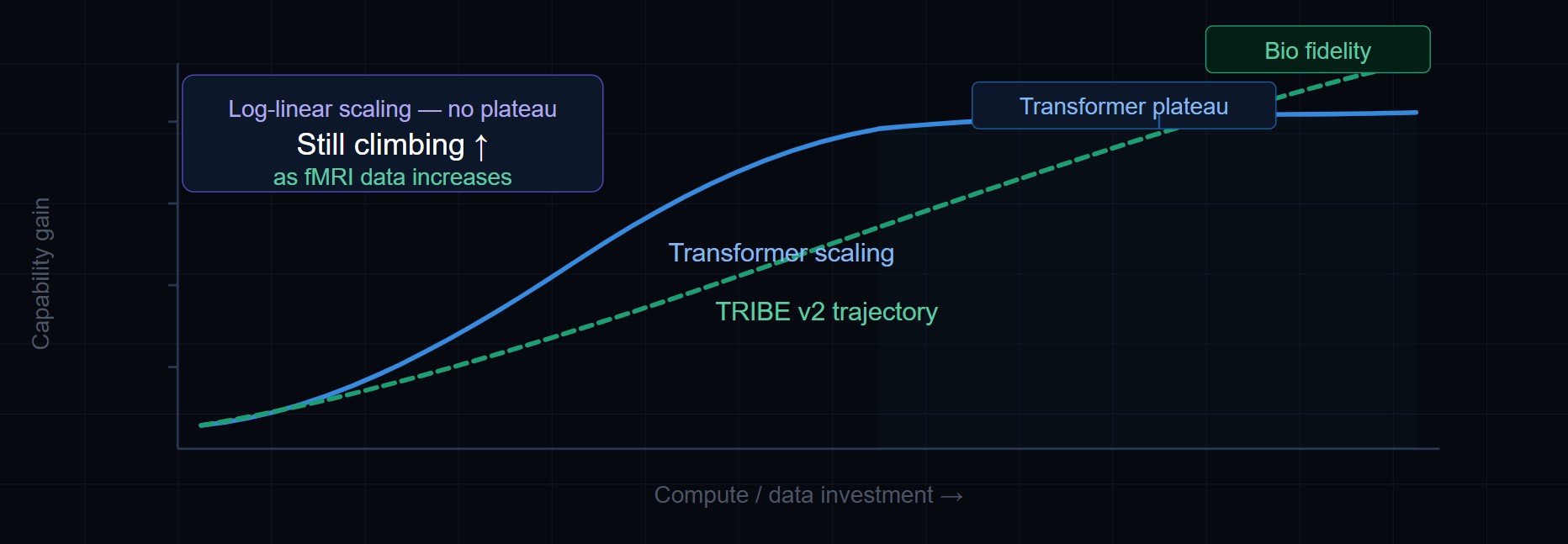 The problem is that scaling laws describe statistical pattern compression, not understanding. Autoregressive transformers—the architecture underpinning virtually every frontier model—are next-token predictors. They optimize for a single objective: given a sequence of tokens, predict what comes next. This is a powerful inductive bias for language, but it is not a model of how perception, cognition, or semantic grounding actually work in biological systems.
Three hard ceilings have emerged simultaneously.
The Compute Ceiling. Training a frontier model today requires tens of thousands of specialized accelerators running for months. A single training run for a GPT-4-class model consumes electricity equivalent to the annual power consumption of a small town. The carbon cost and capital expenditure are stratospheric for any entity that is not a trillion-dollar corporation or a sovereign nation with state-level ambitions.
The Data Wall. The web is finite. High-quality text data—the kind that actually improves model reasoning rather than just inflating token counts—has effectively been exhausted. Frontier labs are now training on synthetic data generated by previous models, a process that introduces compounding distributional drift. The snake is eating its tail.
The Grounding Gap. Transformers learn statistical co-occurrences between tokens. They have no privileged access to the physical or perceptual world those tokens describe. A language model can describe the color red with perfect fluency without any internal representation of what redness is to a perceptual system. This is not a solvable problem within the transformer-scaling paradigm—it is definitional to it.
The Biological Turn
What TRIBE v2 represents is not merely a new model. It is a pivot in the epistemological foundation of AI research—away from "build a bigger statistical compressor" and toward "model the computational substrate that evolution spent 500 million years optimizing."
The human brain processes sensory inputs at roughly 20 watts of metabolic power. It generalizes instantly from a single example. It transfers knowledge between modalities without fine-tuning. It handles novel stimuli without distribution shift failures. These are not academic curiosities—they are engineering specifications that current architectures cannot match.
TRIBE v2 does not replicate the brain. But it does something prerequisite: it builds a quantitatively accurate predictive model of brain activity, trained on direct neuroimaging data, that generalizes to new humans, new languages, and new perceptual tasks it has never seen. That is the first rigorous, empirically validated step toward what computational neuroscientists call biologically-constrained AI design.
Section 2: Deep Dive into TRIBE v2 Technical Architecture
The Training Corpus: 1,117 Hours of Human Neural Reality
To understand why TRIBE v2 is architecturally distinct, start with its training data. This is not synthetic. It is not scraped from the internet. It is direct measurement of human brains at work.
The model was trained on 451.6 hours of fMRI recordings from 25 subjects, then evaluated on a unified dataset of 1,117.7 hours of neural recordings from 720 healthy volunteers. These subjects were exposed to naturalistic, multimodal stimuli during scanning: movies with synchronized audio, podcast recordings, silent videos, and text passages. Real-world media—not controlled laboratory nonsense designed to isolate a single cognitive variable.
Functional magnetic resonance imaging measures the BOLD signal—Blood Oxygen Level-Dependent contrast—a proxy for neural firing rates across discrete three-dimensional units called voxels. Each voxel represents a small cube of brain tissue, roughly 1–3mm per side depending on scanner resolution. High-resolution cortical imaging can produce a grid of tens of thousands of such voxels, each carrying a time-series of activation values as stimuli unfold.
TRIBE v2's task is to take a multimodal stimulus as input and predict the activation value at each of approximately 70,000 cortical voxels. Not approximately. Not in coarse anatomical regions. At the level of individual voxels, capturing the granular topographic organization of the visual cortex, auditory cortex, language networks, and association areas simultaneously.
The Three-Stage Architecture: Encoding, Integration, Brain Mapping
TRIBE v2 runs a three-stage pipeline, and understanding each stage reveals why it achieves what prior approaches could not.
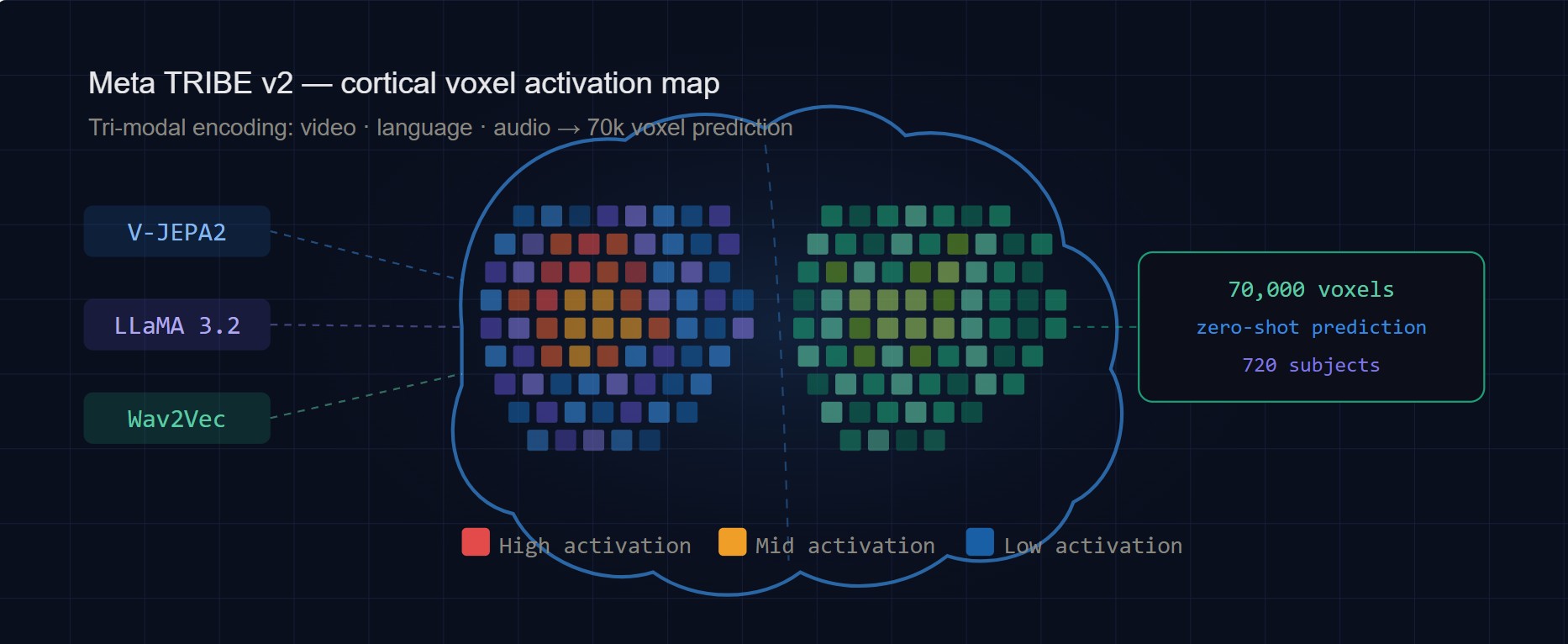
Stage 1 — Modality-Specific Encoding. Each sensory channel is processed by a best-in-class pretrained foundation model, kept frozen during TRIBE v2 training:
- Text: LLaMA 3.2-3B extracts linguistic embeddings.
- Video: V-JEPA2-Giant processes 64-frame video segments spanning 4-second windows. V-JEPA2 is itself a self-supervised joint-embedding predictive architecture—trained to predict masked spatiotemporal regions of video without pixel-level reconstruction, forcing the model to learn compact semantic representations.
- Audio: Wav2Vec-BERT 2.0 processes acoustic signals, resampled to a 2 Hz grid synchronized to the fMRI acquisition frequency.
The choice to freeze these encoders is deliberate and critical. The encoders are not being trained to predict brain activity—they are being used as fixed feature extractors. TRIBE v2 learns how the representational geometry of existing AI architectures maps onto the geometry of neural response spaces. This is alignment in the literal, mathematical sense.
Stage 2 — Temporal Integration. A Transformer-based integration module—8 attention layers, 8 heads per layer—fuses the tri-modal embeddings across a 100-second temporal window. The model learns cross-modal dependencies: how the brain's response to a spoken word modulates based on concurrent visual information, how semantic context from text interacts with auditory processing. This is where TRIBE v2 captures the dynamic, time-unfolding nature of cognition during natural perception.
Stage 3 — Brain Mapping. A subject-specific mapping layer projects the integrated representation onto the full cortical surface of each individual. This layer is where TRIBE v2 learns both the universal structure of human neural processing and the individual variability across subjects—the fact that your auditory cortex responds to speech slightly differently than mine, but both follow the same underlying computational logic.
The 70-Fold Resolution Increase: What Changed From v1
TRIBE v1—the architecture that won the Algonauts 2025 Challenge—was trained on just four subjects and predicted approximately 1,000 coarse cortical voxels. Strong enough to win an international competition. Insufficient for granular neuroscience.
TRIBE v2 maps 70,000 voxels. This is not merely a scaling-up. Several architectural and dataset innovations drove the jump:
- The unified training corpus aggregated fMRI datasets from multiple independent labs worldwide, solving the per-lab data scarcity problem.
- Subject-specific projection layers allow the model to learn a shared cortical "grammar" while accommodating individual anatomical and functional variability.
- The frozen encoder strategy prevents the modality-specific modules from overfitting to any single subject's brain, forcing generalization through representation quality rather than memorization.
- Log-linear scaling behavior was confirmed: prediction accuracy keeps rising as more fMRI data is added, with no performance plateau currently visible in the scaling curve.
At 70,000 voxels, TRIBE v2 can distinguish the brain's differential response to a human face versus a landscape, to English versus Mandarin, to emotional speech versus neutral narration—at the level of individual cortical columns.
Decoding Zero-Shot Generalization: The Mechanism
The most scientifically significant capability of TRIBE v2 is its zero-shot generalization: accurate neural response prediction for subjects the model has never seen, stimuli it has never encountered, and tasks it was never explicitly trained on.
The table below compares standard representation learning with TRIBE v2's functional biological mapping:
| Dimension | Standard Representation Learning | TRIBE v2 Functional Biological Mapping |
|---|---|---|
| Objective | Minimize task loss on training distribution | Predict voxel-wise neural activation from stimulus features |
| Generalization unit | New data points from same distribution | New humans with different cortical geometry |
| Supervision signal | Labels, contrastive pairs, or masked tokens | Direct fMRI BOLD measurements from 720 subjects |
| Modality integration | Late fusion or shared embedding space | Temporal Transformer across tri-modal embeddings |
| Novel task transfer | Requires fine-tuning or in-context examples | Zero-shot; driven by pretrained encoder representations |
| Resolution of output | Task-level predictions | 70,000 individual cortical voxels |
| Biological grounding | None; purely statistical | Direct: trained to match biological neural response |
Zero-shot generalization in TRIBE v2 works because the model learns a functional mapping rather than a subject-specific mapping. The frozen encoders (LLaMA, V-JEPA2, Wav2Vec-BERT) produce representations that capture the semantic and perceptual structure of stimuli in a way that is universally predictive of neural responses across the human population. The brain mapping layer then learns to decode these universal representations into subject-specific activation patterns. When confronted with a new subject, the universal representations remain valid—only the individual-level readout needs adjustment, and this generalizes surprisingly well without any retraining.
On the HCP 7T dataset—an entirely independent, high-resolution fMRI benchmark—TRIBE v2's zero-shot group-averaged predictions achieved correlation near 0.4, doubling the predictive accuracy of the median individual subject's own recorded response. That last point deserves emphasis: the model's prediction of a brain's average response to a stimulus is more accurate than using a single human subject's actual data. This reflects genuine generalization of biological principles, not overfitting to training subjects.
TRIBE v2 also identified five functional networks through emergent internal representations alone—primary auditory, language, motion, default mode, and visual networks—without any explicit anatomical supervision. These correspond precisely to networks that neuroscientists have spent decades characterizing through careful experimental design. The model learned them from naturalistic stimuli and fMRI data alone.
Academic References
| Reference | Relevance |
|---|---|
| d'Ascoli, Stéphan, et al. (2026). A foundation model of vision, audition, and language for in-silico neuroscience. Meta FAIR. | Primary TRIBE v2 paper; architecture, dataset, evaluation |
| Kaplan, J., et al. (2020). Scaling laws for neural language models. arXiv:2001.08361 | Transformer scaling law baseline for comparison |
| Gifford, A.T., et al. (2023). The Algonauts Project 2023: How the Human Brain Makes Sense of Natural Scenes. arXiv:2301.03198 | Foundation for brain encoding challenge methodology |
| Assran, M., et al. (2023). Self-supervised learning from images with a joint-embedding predictive architecture. CVPR 2023 | V-JEPA lineage; basis for V-JEPA2 encoder |
| Baevski, A., et al. (2020). wav2vec 2.0: A framework for self-supervised learning of speech representations. NeurIPS 2020 | Wav2Vec-BERT 2.0 encoder lineage |
| Huth, A.G., et al. (2016). Natural speech reveals the semantic maps that tile human cerebral cortex. Nature, 532, 453–458 | Foundational work on semantic organization in the brain |
| Nature Machine Intelligence peer review track on computational neuroscience foundation models (ongoing, 2026) | Anticipated venue for independent validation of TRIBE v2 methodology |
Section 3: The Convergence of In Silico Neuroscience and AI Hardware
The Feedback Loop: Brain Models Informing Silicon Design
TRIBE v2 establishes a feedback loop that did not previously exist at this fidelity. Researchers can now run thousands of virtual brain experiments—testing how specific stimuli activate specific cortical regions—without booking scanner time, recruiting subjects, or waiting months for data analysis. The Pebblous AI research team estimated that answering a single question ("how does this stimulus activate the prefrontal cortex?") dropped from a multi-year research project to a computation taking seconds.
But the loop runs in both directions. When TRIBE v2's internal representations—learned from raw biological data—are examined, they reveal which computational structures are causally predictive of neural activity. This is not a minor academic curiosity. It is a direct readout of what kinds of transformations the brain actually performs on sensory input. And those transformations are radically different from what a standard autoregressive transformer does.
The human visual cortex processes information in a sparse, hierarchical, event-driven fashion. V1 neurons respond to edges and orientations with extreme selectivity. Higher visual areas encode objects and scenes using population codes distributed across thousands of neurons, not concentrated in individual "concept neurons." Temporal processing in auditory cortex is phase-locked to acoustic structure at millisecond resolution—far finer than the 2 Hz fMRI resolution that TRIBE v2 currently operates at. The brain does not run dense matrix multiplications across all its parameters for every input token. It routes signals sparsely, activating only the circuits relevant to the current stimulus.
This is where the physics of silicon hardware starts to push back against the standard GPU-centric AI stack.
The Case Against Monolithic GPU Clusters
A modern H100 GPU executes dense tensor operations at peak efficiency—but only when those tensors are large and uniform. Its architecture is designed for the algebraic structure of backpropagation through dense layers. This makes it ideal for training transformers. It makes it deeply inefficient for sparse, event-driven, biologically-structured inference.
The human brain operates on roughly 20 watts. An H100 server draws 700 watts per GPU, and frontier training runs require 25,000 GPUs. The energy gap is not an engineering oversight—it is a fundamental consequence of architectural mismatch. Dense computation on uniform hardware cannot replicate the efficiency of sparse, local, spike-driven computation on heterogeneous neural circuits.
What TRIBE v2 does, by building accurate computational models of biological neural processing, is generate the ground truth specifications that next-generation neuromorphic hardware needs to match. Every identified functional network, every voxel-level response profile, every cross-modal integration pattern is a constraint that hardware architects can target.
Neuromorphic Hardware: From Research Curiosity to Engineering Specification
Neuromorphic chips have existed in research labs for decades—Intel's Loihi 2, IBM's NorthPole, SpiNNcloud's SpiNNaker2. They implement Spiking Neural Networks (SNNs) in silicon: artificial neurons that fire discrete electrical spikes rather than passing continuous activation values, communicate locally rather than globally, and compute only when input changes—event-driven rather than clock-driven. Intel's Loihi 2, for example, packs one million neurons and 120 million synapses while demonstrating up to 100× greater energy efficiency on specific AI tasks compared to GPUs.
The challenge has always been: what do you run on these chips? Traditional deep learning models—transformers, CNNs—do not map naturally onto spiking architectures. Converting a trained dense network to SNN form degrades accuracy substantially. The SNN programming model has lacked the equivalent of PyTorch.
TRIBE v2 changes the terms of this problem. By producing faithful models of biological neural computation—sparse, hierarchical, temporally structured—it generates the training targets for neuromorphic systems. The model identifies how the brain integrates auditory and visual information over 100-second windows using 8-head attention across modalities. That is an architectural blueprint, not just a neuroscience result.
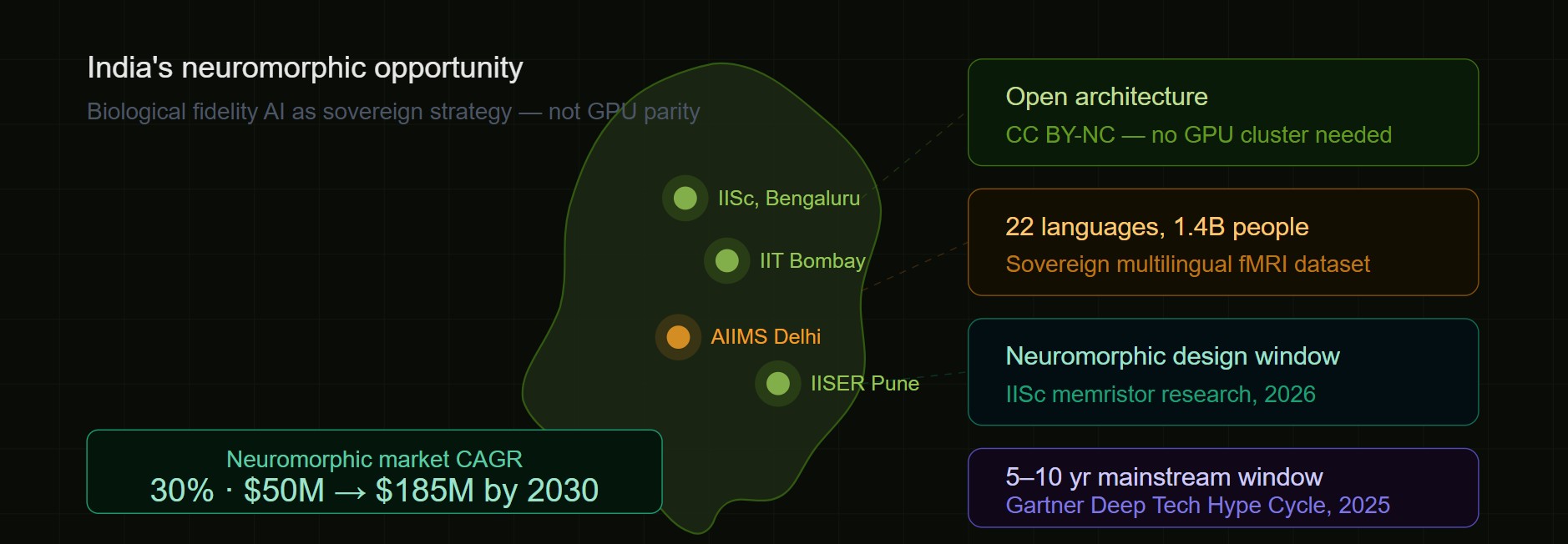
The global neuromorphic and brain-inspired AI computing hardware market generated approximately $50 million in commercial revenue in 2025 and is projected to reach $185 million by 2030 at a 30% CAGR—still tiny relative to the GPU market, but the trajectory is steepening precisely because models like TRIBE v2 are providing the missing architectural specifications.
Section 4: The Strategic View for the Indian AI Ecosystem
Why Biological Fidelity Matters More Than Data Center Parity
India's sovereign AI ambitions face a structural problem: the brute-force scaling game is already decided. The hyperscalers—Microsoft, Google, Amazon, Meta—have locked in multi-hundred-billion-dollar commitments to GPU infrastructure, energy procurement, and proprietary dataset collection. Any strategy premised on catching up to this stack by building equivalent infrastructure is not a competitive strategy. It is an expensive participation trophy.
TRIBE v2 and the biological fidelity paradigm open a different axis of competition—one where India's specific strengths are actually advantages rather than liabilities.
Research talent is asymmetric. India produces over 1.5 million engineering graduates annually. The IITs, IISc, and IISERs have strong computational neuroscience and signal processing traditions. TRIBE v2's architecture—three frozen foundation models feeding into a temporal Transformer with a subject-specific readout layer—is buildable and extensible within a well-funded academic lab. Meta has released the model weights, full codebase, and paper under a CC BY-NC license on Hugging Face (facebook/tribev2) and GitHub (facebookresearch/tribev2). The entry ticket is not a $100 million compute cluster. It is a team of rigorous researchers and access to a high-end multi-GPU workstation.
IISc is already moving. In late 2024, researchers at the Indian Institute of Science in Bengaluru announced a brain-inspired computing platform. In January 2026, IISc published work on molecularly engineered memristors for reconfigurable neuromorphic functionalities—shape-shifting molecules that can store information, perform computation, and adapt within the same physical structure in real time. These are not incremental results. Memristive neuromorphic hardware represents one of the four major architecture categories in the emerging non-GPU AI hardware market, alongside digital neuromorphic chips, analog/mixed-signal systems, and superconducting optoelectronic architectures.
The clinical opportunity is concrete and local. TRIBE v2 was explicitly designed to accelerate breakthroughs in neurological disease diagnosis and treatment. India carries one of the world's largest burdens of neurological disease—stroke, epilepsy, dementia, traumatic brain injury—with severe shortages of specialist neurologists, particularly outside tier-1 cities. A computational brain twin that can predict neural response patterns without an fMRI scanner is not just a research tool. It is a pathway to scalable, low-cost neurological screening tools deployable at the edge.
The language diversity advantage. TRIBE v2's zero-shot generalization extends explicitly to unencountered languages. India has 22 officially recognized languages and hundreds of dialects with distinct phonological and syntactic structures. Studying how the brain processes Hindi versus Tamil versus Bengali versus Odia—and whether the neural substrate of language processing shows the cross-linguistic universals that linguists have theorized—is a research program that Indian institutions can own. The dataset does not need to be collected in a Western country. It needs to be collected with scientific rigor and multimodal synchrony. Indian hospitals and research universities can do this.
The Neuromorphic Production Opportunity
India's semiconductor policy under programs like the India Semiconductor Mission has focused primarily on fab establishment and ATMP (Assembly, Testing, Marking, and Packaging). This is strategically reasonable for catching up on conventional chips. But neuromorphic chip architecture—fundamentally different from von Neumann silicon—represents an area where there is no 30-year manufacturing gap to close. The design principles are still being established globally.
Gartner's Deep Technology Hype Cycle (2025) placed neuromorphic computing 5–10 years from mainstream adoption. That window is now. Organizations that build neuromorphic design expertise in the next 3 years will define the architecture of AI hardware in 2030–2035. India's Materials Research Centres and semiconductor design houses have the talent pipeline to compete in this window—if policy priorities and research funding align to neuromorphic hardware design rather than chasing DRAM manufacturing.
Building Sovereign Datasets: The Hidden Infrastructure Play
Every major AI capability depends on training data. For biological fidelity models like TRIBE v2, the relevant training data is human neural response data—fMRI recordings collected under controlled, multimodal stimulus conditions. This data is expensive, slow to collect, and non-synthetic. It cannot be scraped from the internet.
India's population diversity makes it uniquely valuable as a source of neural training data. Cross-cultural, cross-linguistic fMRI datasets collected from Indian subjects—watching Indian cinema, listening to Indian music, reading texts in Indian languages—would create a sovereign neurological dataset with scientific value and geopolitical importance that no amount of GPU compute can substitute.
The Digital India initiative and research funding bodies like SERB and DBT have the mandate to fund exactly this kind of foundational data infrastructure. The cost of a multi-site, multi-language fMRI dataset collection program across 5 major Indian cities would be a rounding error compared to the capital cost of building a competing transformer training cluster—and the strategic moat it creates is genuinely defensible.
Section 5: What TRIBE v2 Is Not—and Why the Distinction Matters
Clarity is a form of rigor. TRIBE v2 is specifically a brain encoding model—it takes a stimulus as input and predicts the brain's response. It is emphatically not a brain decoding model. It cannot reconstruct thoughts, inner speech, or intentions from neural signals. The encoding-decoding distinction is not pedantic—it is the difference between a scientific instrument and a surveillance technology.
Meta's FAIR team made this boundary explicit in their release materials, and it warrants emphasis in any honest discussion of the technology. The model answers one question: given this sensory input, what would the brain do? It does not answer the inverse: given what the brain is doing, what is the person thinking? The latter problem remains substantially harder and is not what TRIBE v2 addresses.
This matters for the Indian policy context. Regulators developing AI governance frameworks should understand that biological fidelity AI—at its current stage—is a scientific modeling tool, not a privacy threat. The appropriate regulatory posture is one that enables research while establishing clear boundaries against decoding applications that might eventually approach cognitive privacy concerns.
Conclusion: The Paradigm Is Not Replacing Transformers—It Is Completing Them
Biological fidelity models do not make transformers obsolete. They reveal what transformers are missing. The representational geometry that TRIBE v2 aligns to brain activity—derived from LLaMA, V-JEPA2, and Wav2Vec-BERT—suggests that these architectures capture more of the structure of biological perception than their task-level benchmarks indicated. That is a finding worth building on.
The deeper insight is structural: the scaling era produced powerful statistical machines. Biological fidelity research produces grounded machines—models whose internal representations can be validated against the most sophisticated information processor we know of. The two traditions are not competing. They are convergent.
For the Indian AI ecosystem, the question is not whether to participate in the biological fidelity paradigm. The question is where to place bets, how fast to move, and which institutional structures can execute. The data collection opportunity is real. The hardware design window is open. The research talent exists. TRIBE v2 is openly released. The architecture is documented. The scaling law is still climbing.
The only thing missing is urgency.
IndianAI.in publishes deep-technical analysis at the intersection of AI research, policy, and sovereign capability. TRIBE v2 model weights and code are available at github.com/facebookresearch/tribev2 and huggingface.co/facebook/tribev2 under CC BY-NC license.